
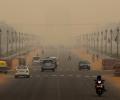
Dense fog enveloped Delhi for a second consecutive morning, leading to disruptions in air and rail traffic. Visibility dropped to zero in several areas, causing delays for 81 trains and diversions for 15 flights. The Met office attributed the fog to calm surface winds, and predicted continued dense to very dense fog throughout the day. Meanwhile, the national capital's air quality remained in the 'very poor' category, with an AQI reading of 380 at 9 am.

With such announcements grabbing the voters' attention, critical issues like pollution, especially the smog that chokes Delhi every winter, remain largely unaddressed. Many residents have raised concerns over the lack of concrete action plans to combat air pollution, which continues to pose a severe health risk to Delhiites.
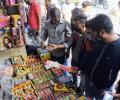
The Delhi government has been following the practice of banning all kinds of firecrackers for the last three years.

The air quality is expected to improve further due to wind speed favourable for the dispersion of pollutants.

The poisonous haze has been causing significant problems for people with existing respiratory issues, according to doctors.

This time, Delhi saw a sharp improvement in air quality just ahead of Diwali which can be attributed to intermittent rainfall on Friday and wind speed favourable for the dispersion of pollutants.
The top court did some tough-talking and had warned that the administration at large will be made accountable even if there is a single incident of stubble burning henceforth.

Amid rising air pollution caused by the burning of crop residue, the Bihar government has decided to identify farmers who are indulging in this practice and put up their names at the block offices, officials said on Saturday.
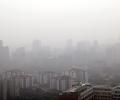
Air quality in Delhi and its suburbs dropped to the severe category again on Wednesday morning, with smoke from post-harvest paddy straw burning in neighbouring states accounting for one-third of the air pollution in the national capital.
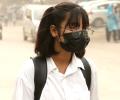
Dr Sneha Tirpude, pulmonologist at Pune's Ruby Hall Clinic, suggests simple measures to protect your lungs when the air quality is poor.

The national capital on Friday recorded a 24-hour average air quality index of 239. On Thursday, it was 315, the worst since February 12 when the AQI was 320.

The maximum temperature on Saturday settled at 18.1 degrees Celsius, two notches below the season's average, and the minimum was recorded at 3.6 degrees Celsius, four notches below the season's average, the IMD said.

'Covid patients have infected lungs and the pollutants will further damage it.'

According to the System of Air Quality and Weather Forecasting and Research, the overall air quality of the national capital docked at 376 at 8:30 am on Tuesday.

A CPCB official said a number of factors were responsible for the deteriorating air quality, including vehicular pollution, construction activities and meteorological factors.

According to the Graded Response Action Plan (GRAP), the air quality is considered to be in the emergency category if the PM2.5 and PM10 levels continue to be above 300 micrograms per cubic metre and 500 micrograms per cubic metre respectively for 48 hours or more.

An improvement in the wind speed November 21 onwards might bring air pollution levels down.

Long-term exposure to chronically high PM2.5 levels weakens the ability of the lungs to fend off infections, therefore making people more susceptible to COVID-19, the scientists said.

Delhi Chief Minister Arvind Kejriwal announced that primary schools will be closed from Saturday in view of spike in pollution levels in the national capital.

Delhi recorded an air quality index of 315 at 11:10 am. The last time the air quality hit such a poor level was in February.

Environment Minister Harsh Vardhan on Tuesday instructed the states in the National Capital Region to take all possible measures to prevent any spike in air pollution levels during the upcoming Under-17 FIFA World Cup in Delhi to save India the blushes.
'If we don't control the additional pollutants that come from various human activities then, the pollution level will not come down.'

Firecrackers were burst outside the CM's residence after his release from the Tihar Jail on Friday evening. The Aam Aadmi Party workers had gathered to welcome their leader.

Ahead of the Delhi assembly polls scheduled to be held early next year, state Congress chief Devender Yadav said on Friday that the party will contest on all 70 seats and there would be no alliance.
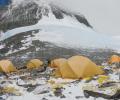
Nepal has sharply increased permit fees for climbing Mount Everest by 36 per cent and also introduced a slew of measures aimed at controlling garbage pollution on the world's tallest peak, officials said.
Here's what the national capital needs to do to ensure the residents stop breathing toxic fumes.

The city's air quality index will fluctuate between the higher end of the "poor" category and the lower end of the "very poor" category, it predicted.
Report by Greenpeace also presented a grim picture of India's pollution level.

The meeting was focussed on air pollution and stubble burning.

The air quality in Delhi remained poor Sunday with drop in wind speed even as authorities predicted further fall in air quality index of the national capital in the coming days.

The Supreme Court on Wednesday refused to interfere with the Delhi government's order putting a comprehensive ban on manufacturing, storage, sale and bursting of firecrackers in the city, saying people's health is important.
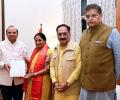
The monthly Rs 2500 payment for poor women is expected to cost Rs 11,000 crore while the pension scheme of Rs 2000 for every senior citizen will cost around Rs 4100 crore. The Yamuna clean up will cost over Rs 10,000 crore while a similar amount is required to upgrade Delhi's hospitals. Ultimately, the new BJP government will have no choice but to ask the centre for financial support, notes Rashme Sehgal.
'The answer is no, the entire country's is.' 'So why such obsession with Delhi?' 'But the most powerful people in India live here: The prime minister, civil servants, Supreme Court judges, MPs, diplomats, dadas of the media...' 'If they can't deal with their own problem, what chance does the rest of the country have, with its foul air, dying rivers, frothing lakes, and crumbling mountains?' says Shekhar Gupta.

A bench of Justices Sanjay Kishan Kaul and Sudhanshu Dhulia also suggested why should there be any purchase under the minimum support price system from farmers who indulge in crop residue burning, irrespective of the fact that citizens and children were affected due to pollution.

A blinding layer of dense fog over north India, including Delhi, caused major inconvenience to commuters. The visibility levels were 50 metres around 5:30 am.

The spurt in pollutants was caused by a combination of meteorological factors including a drop in temperature, wind speed and mixing height, a layer where air and particulates float, the Central Pollution Control Board said.

The minimum temperature in the national capital on Saturday settled at 10.2 degrees Celsius, three notches above the season's average, it said.

The dip in the air quality can be attributed to low wind speed and temperatures which allowed accumulation of pollutants.
Delhi woke up to the season's worst air quality as smoke from Diwali fireworks, coupled with moisture and nearly stagnant wind movement, shrouded the city in a thick cover of smog with respirable pollutants reaching perilous levels.

Amid criticism over the formation of foam in the Yamuna -- a sign of its hazardous water quality -- the Delhi government on Tuesday deployed 15 boats to remove the froth with the help of ropes.
